XML external entity injection: A security architect's perspective (Part 2)
In Part 1 of this series, we examined XXE injection from a developer's perspective, covering secure coding patterns across DocumentBuilderFactory, SAXParser, StAX, TransformerFactory, JAXB, and Jackson XML. We also explored file upload dangers and automated detection strategies.
This part shifts focus from code to strategy. Security architects must translate vulnerability knowledge into organizational controls, risk frameworks, and measurable security programs. Knowing how to fix XXE is necessary but insufficient. The real challenge is building systems and processes that prevent these vulnerabilities from reaching production in the first place.
The program machinery every vulnerability class shares, including the core metrics, the four-gate model, remediation SLAs and escalation, developer training and security champions, and the incident response lifecycle, is covered in Building an Application Security Metrics Program: Measuring What Actually Matters. This post builds on that foundation instead of repeating it and stays with what XML parsing changes.
According to the OWASP Top 10 2025, XXE falls under A02:2025 Security Misconfiguration (CWE-611 Improper Restriction of XML External Entity Reference). This classification is significant. XXE is not primarily a coding logic error but a configuration failure. Every tested application in the OWASP dataset showed some form of misconfiguration, and XXE represents one of the most dangerous manifestations of this category.
1. Threat modeling XXE
Before implementing controls, security architects must understand the threat landscape. XXE is not a monolithic risk. Different attack scenarios carry different business impacts and require different mitigation strategies.
Attack scenarios and business impact
Data Exfiltration
The most common XXE objective is unauthorized data access. Attackers read configuration files containing database credentials, API keys, or encryption secrets. They extract customer records, financial data, or intellectual property. The business impact includes regulatory fines under GDPR, PCI-DSS, or HIPAA, along with reputational damage and customer churn. A single successful exfiltration through an XXE vulnerability can cost millions in breach notification, legal fees, and remediation. IBM's Cost of a Data Breach Report 2026 puts the global average at USD 4.99 million per breach.
Server-Side Request Forgery
XXE provides a reliable SSRF vector. Attackers use the parser to probe internal networks, access cloud metadata services, or pivot to backend systems. On AWS instances that still allow IMDSv1, this means stealing IAM role credentials from the metadata endpoint. On internal networks, it means scanning for services and exploiting internal APIs that lack authentication because they were never intended to be internet-accessible.
Denial of Service
The billion laughs attack and similar entity expansion patterns can crash applications or consume resources wherever the parser does not enforce expansion limits. Even without data theft, extended downtime translates directly to revenue loss and SLA violations. Resource exhaustion attacks are particularly insidious because they can be automated and scaled.
Blind Data Extraction
Even when applications do not reflect parsed content, attackers extract data through out-of-band channels. Error messages, DNS lookups, and HTTP callbacks all serve as exfiltration vectors. Blind XXE often goes undetected longer because there is no obvious response manipulation.
Mapping to STRIDE
Security architects often use the STRIDE model to categorize threats. XXE maps across multiple categories:
| STRIDE Category | XXE Manifestation |
|---|---|
| Spoofing | Reading credentials to impersonate services |
| Tampering | Modifying data through chained attacks |
| Repudiation | Parser-initiated file reads and callbacks rarely appear in application audit logs |
| Information Disclosure | Extracting files, credentials, internal data |
| Denial of Service | Billion laughs, resource exhaustion |
| Elevation of Privilege | Stealing admin credentials, accessing internal services |
This multi-category impact explains why XXE consistently appears in security assessments. It is not a single threat but a gateway to many.
Attack tree analysis
A simplified attack tree for XXE helps identify control points:
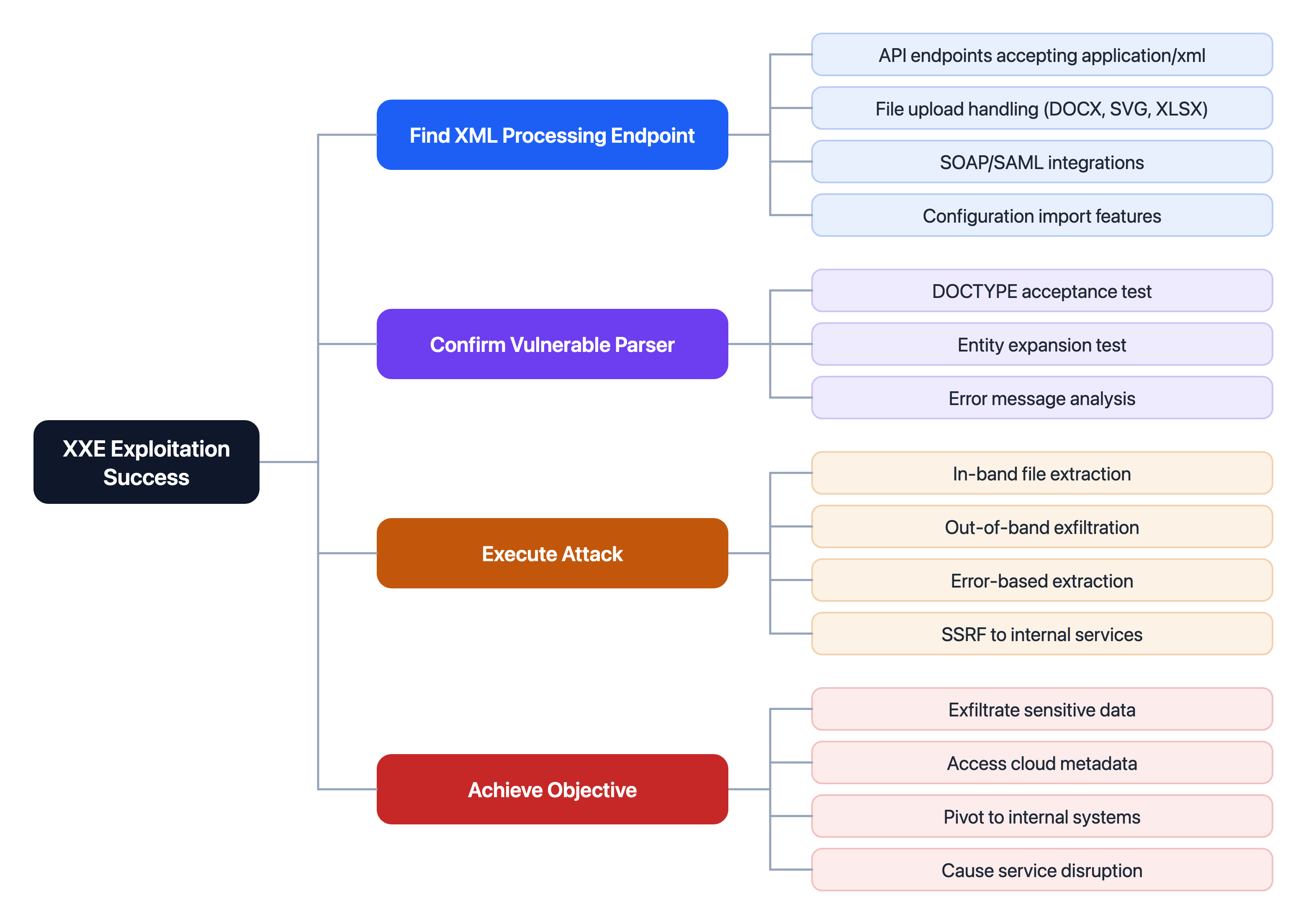
Each node represents an opportunity for controls. Defense in depth means placing obstacles at multiple points, so failure at one level does not mean complete compromise.
2. Risk-based prioritization
Not all XXE findings require immediate remediation. Security architects must prioritize based on risk, balancing security investment against business constraints.
CVSS contextualization
The Common Vulnerability Scoring System provides a baseline, but raw CVSS scores lack business context. An XXE vulnerability in an internal document converter differs dramatically from one in a customer-facing SAML processor.
CVSS v4.0 is the current version. It drops the v3.1 Scope metric and scores impact on the vulnerable system separately from impact on subsequent systems. That split fits XXE well: the parser host is the vulnerable system, while the metadata service or internal API reached through SSRF is a subsequent system.
Base Metric Values for XXE:
| Metric | Typical Value | Reasoning |
|---|---|---|
| Attack Vector (AV) | Network | Most XXE is exploited via HTTP |
| Attack Complexity (AC) | Low | No security mechanism has to be evaded once the parser accepts a DOCTYPE |
| Attack Requirements (AT) | None | In-band exploitation needs no race condition or on-path position |
| Privileges Required (PR) | None/Low | Often exploitable without authentication |
| User Interaction (UI) | None | Server-side processing, no user action needed |
| Vulnerable System Confidentiality (VC) | High | Direct file read capability |
| Vulnerable System Integrity (VI) | None | The parser reads files; it does not write them |
| Vulnerable System Availability (VA) | None/High | Entity expansion DoS depends on the parser's expansion limits |
| Subsequent System Confidentiality (SC) | None/High | SSRF can expose cloud metadata credentials or internal service data |
| Subsequent System Integrity and Availability (SI/SA) | None/Low | SSRF can call internal endpoints that change state on a GET |
Under CVSS v4.0, a classic unauthenticated file-read XXE (CVSS:4.0/AV:N/AC:L/AT:N/PR:N/UI:N/VC:H/VI:N/VA:N/SC:N/SI:N/SA:N) scores 8.7. Scoring the high end of every impact row in this table (VC:H/VI:N/VA:H/SC:H/SI:L/SA:L) takes it to 9.3. Many scanners and advisories still publish CVSS 3.1 scores, and the two versions calculate differently, so state the version and vector you used; environmental factors matter enormously.
Environmental Adjustments:
Consider whether the vulnerable system is internet-facing or internal only. Evaluate what data is accessible from the server's file system and network position. Assess whether compensating controls exist such as WAF rules or network segmentation. Determine the system's business criticality and data classification.
CVSS v4.0 records these adjustments in its Threat and Environmental metric groups and labels the result CVSS-BT, CVSS-BE, or CVSS-BTE. The internal document converter from above, reachable only from a restricted administrative network (MAV:A) and holding low-sensitivity data (CR:L), drops from 8.7 to 5.7 as a CVSS-BE score.
Risk scoring framework
A practical risk scoring approach for XXE findings:
| Factor | Weight | Scoring Criteria |
|---|---|---|
| Data Accessibility | 30% | Credentials/secrets = Critical, PII = High, Internal = Medium |
| Exposure | 25% | Internet = High, Partner network = Medium, Internal = Low |
| Exploitability | 20% | No auth + in-band = High, Auth required or blind = Medium |
| Business Criticality | 15% | Customer-facing = High, Supporting = Medium, Dev/test = Low |
| Compensating Controls | 10% | None = High risk, Partial = Medium, Strong = Low |
Remediation SLAs
Feed the resulting risk level into the remediation SLA, escalation, and exception process defined in the application security metrics program. XXE does not need its own timelines. It needs the factors above, so that a finding in an internet-facing SAML processor that can read secrets lands in the critical tier instead of inheriting a generic severity from the scanner.
3. Security architecture controls
Beyond secure coding, architects design systemic controls that reduce XXE risk across the organization.
Architectural patterns
Centralized XML Processing Service
Instead of allowing XML parsing throughout the codebase, funnel all XML processing through a dedicated service with hardened configuration:
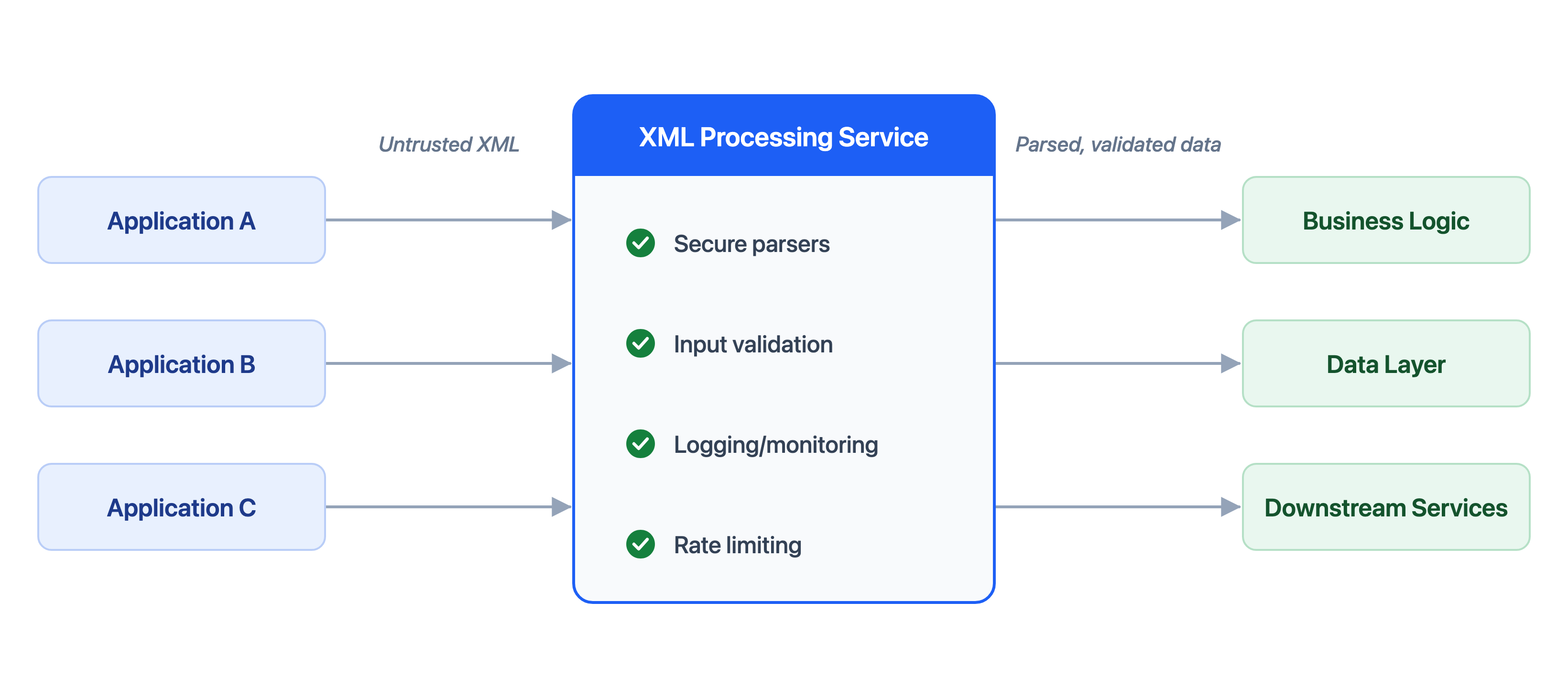
Downstream components receive parsed, validated data, not raw XML they would have to parse again. This pattern enables consistent security configuration across all applications, centralized logging for anomaly detection, single point for security updates, and easier auditing and compliance verification.
API Gateway Validation
For microservices architectures, implement XML validation at the API gateway level. Gateway-level controls include content-type enforcement (reject unexpected XML), request size limits, known attack pattern blocking, and rate limiting per client.
Schema Validation
When XML must be accepted, validate against a strict schema before any business processing. Schema validation rejects unexpected elements and structures, but it parses the document itself, so it is not a fallback for weak parser configuration: harden the SchemaFactory and Validator too (ACCESS_EXTERNAL_DTD and ACCESS_EXTERNAL_SCHEMA set to ""), and validate a DOMSource produced by the already hardened builder.
Network segmentation
Database servers and internal services should never be directly accessible from systems that process untrusted XML. Proper segmentation limits blast radius:
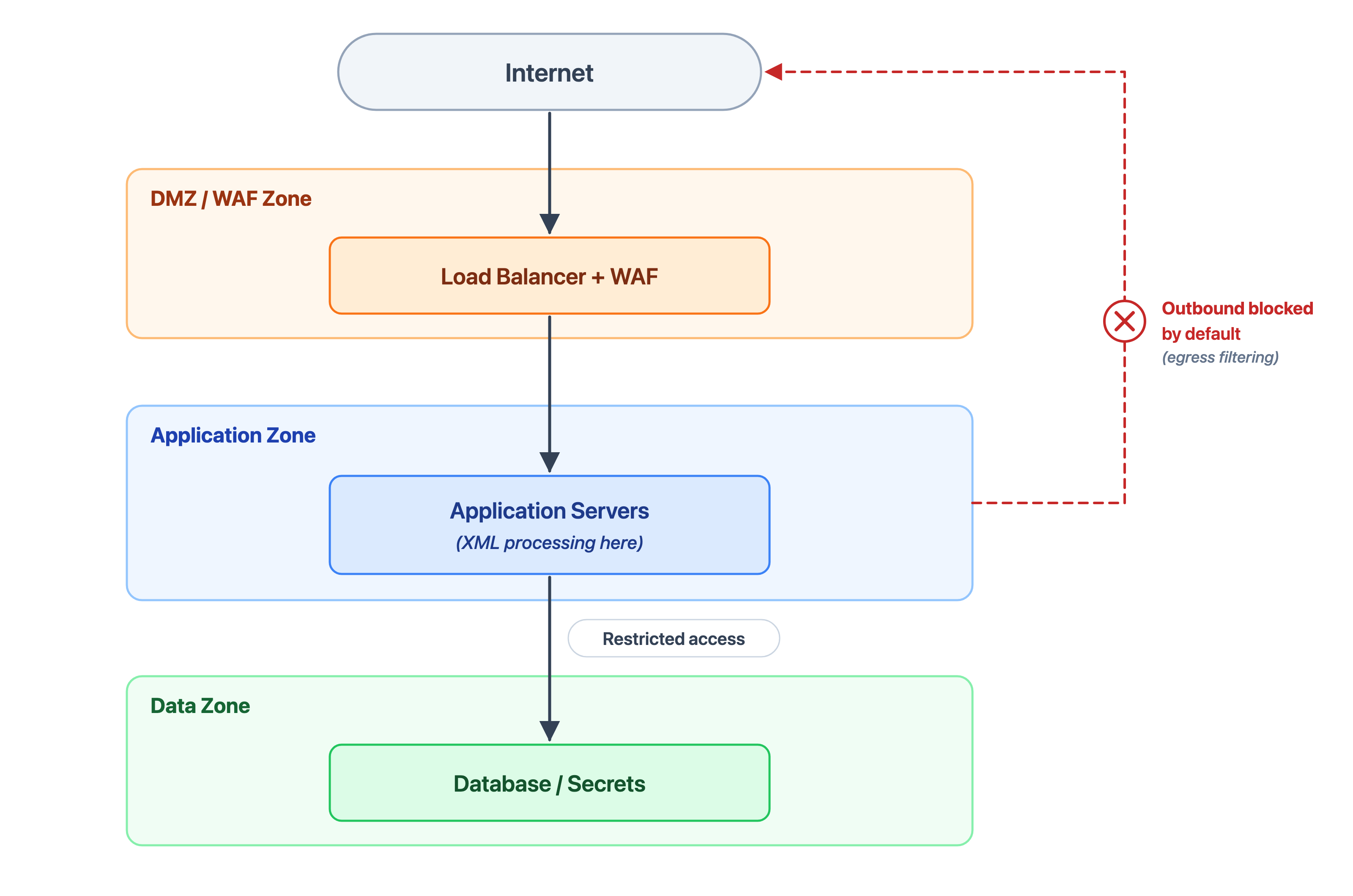
Even with XXE, attackers face additional barriers when trying to access data zone resources or exfiltrate to the internet. The exfiltration barrier exists only when the application zone denies outbound traffic by default, because out-of-band XXE depends on the parser connecting to a host the attacker controls. DNS needs its own control: on AWS, security groups cannot block queries to the VPC resolver, so filtering those lookups takes Route 53 Resolver DNS Firewall.
Cloud metadata protection
On cloud platforms, block access to metadata endpoints from application workloads that do not need them. On AWS, require IMDSv2: an external entity can only issue a plain GET, so it cannot obtain the session token that IMDSv2 demands. Turn the metadata endpoint off on instances that never use it. Keep the PUT response hop limit at 1 where containers have no reason to reach the metadata service, and raise it to 2 only for container workloads that do.
Security groups and network ACLs do not help here, because AWS does not filter traffic to the link-local metadata address with them. Limiting which local processes can reach 169.254.169.254 takes a host firewall rule, such as an iptables owner match for the user that runs the XML processing service.
File upload isolation
Process uploaded files (DOCX, SVG, XLSX) in isolated environments. Container-based processing with minimal file system access limits what XXE can read even if it bypasses parser controls. Network isolation prevents SSRF from uploaded file processing.
4. Compliance and regulatory mapping
XXE vulnerabilities have direct compliance implications. Security architects must understand these mappings to communicate risk in business terms.
PCI DSS 4.0.1 requirements
For organizations handling payment card data, PCI DSS v4.0.1 is the current version of the standard:
| Requirement | XXE Relevance |
|---|---|
| 1.3.2 | Outbound traffic from the CDE limited to what is necessary; default-deny egress also blocks the HTTP and FTP callbacks used for out-of-band exfiltration |
| 6.2.4 | Software engineering techniques prevent or mitigate common software attacks, including injection-type flaws, in bespoke and custom software |
| 6.3.1 | Security vulnerabilities identified and risk ranked |
| 6.4.2 | Automated technical solution for public-facing web applications that detects and prevents attacks |
| 11.3.1 | Internal vulnerability scans performed quarterly |
| 11.4.1 | Penetration testing performed per methodology |
XXE in a cardholder data environment can lead to credential theft and direct card data exposure, jeopardizing PCI compliance status.
GDPR implications
Where the processing falls within GDPR's scope, XXE exposing personal data requires a breach assessment. Article 33 requires the controller to notify the supervisory authority without undue delay and, where feasible, within 72 hours of awareness, unless the breach is unlikely to create a risk to people's rights and freedoms. Article 34 requires communication to affected people without undue delay where a high risk is likely, subject to its exceptions. A breach alone does not establish inadequate Article 32 security measures; document parser controls, testing, and remediation as evidence for that assessment.
The fine ceiling depends on the infringement established: Article 32 falls within the €10 million or 2% of total worldwide annual turnover tier, whichever is higher; an independently established Article 5 infringement can attract the €20 million or 4% tier. These are ceilings, not automatic penalties. See the GDPR text and CJEU judgment summary.
Build the breach process on the current text. The Commission's Digital Omnibus proposal would extend the authority deadline to 96 hours and focus authority notification on higher-risk breaches, but as of October 2026 it is still awaiting a committee decision in the European Parliament, and Article 33 is unchanged.
SOC 2 trust criteria
For SaaS organizations pursuing SOC 2, the current criteria are the 2017 Trust Services Criteria with revised points of focus (2022):
| Trust Criteria | XXE Controls |
|---|---|
| CC6.1 | Logical access architecture limits what the XML processing service can read and reach |
| CC6.6 | Protection against threats from outside the system boundary, such as hostile XML submitted to public endpoints |
| CC7.1 | Vulnerability identification through SAST/DAST |
| CC7.2 | Security events detected through XML parsing logs |
| CC8.1 | Change management for parser configuration |
Auditors will examine parser configuration standards, security testing evidence, and remediation timelines.
HIPAA security rule
For healthcare organizations, XXE vulnerabilities affecting electronic PHI implicate the technical safeguards requirements. An XXE file read bypasses access control (164.312(a)), and audit controls (164.312(b)) decide whether anyone can reconstruct what the parser read. A known XXE finding also belongs in the risk analysis and risk management required by 164.308(a)(1), and an exploited one that read unsecured PHI goes through the Breach Notification Rule's breach assessment.
HHS proposed a substantial Security Rule update in January 2025, including explicit vulnerability scanning, penetration testing, and network segmentation requirements. As of October 2026 it has not been finalized, so the current safeguards above are the ones that apply.
5. Security program integration
XXE prevention must be embedded in the software development lifecycle, not bolted on at the end.
Secure SDLC integration points
Requirements Phase
Security requirements specify that all XML parsing must use organization-approved secure configurations. Threat modeling identifies XML processing points and their data access. Data classification determines what files and services are accessible from XML processing components.
Design Phase
Architecture review validates that XML processing is centralized where possible. Security architects approve parser library selection and configuration standards. Design documents specify which endpoints accept XML and why.
Development Phase
IDE plugins and pre-commit hooks flag creation of XML parser instances without secure configuration. Code templates and libraries provide secure-by-default XML processing. Code review checklists include XXE verification for any XML handling.
Testing Phase
SAST tools scan for unsafe parser instantiation. DAST tools probe for XXE with standard payloads. Penetration testing includes manual XXE attempts against all XML endpoints.
Deployment Phase
Security gates block deployment with critical findings. Configuration management verifies parser settings in deployed artifacts. WAF rules updated for new XML-accepting endpoints.
Operations Phase
Runtime monitoring detects unusual XML parsing patterns. Log analysis identifies potential XXE exploitation attempts. Incident response procedures address successful attacks.
Security gates
he four gates themselves, how to tune them, and how to measure their effectiveness are described in the application security metrics program. For XXE, each gate needs a specific check:
Gate 1: Pre-Commit
Local SAST runs Semgrep or similar tools checking for unsafe parser creation.
Gate 2: Pull Request
Security review required for new XML processing endpoints, including features that accept DOCX, XLSX, or SVG uploads.
Gate 3: CI Pipeline
Integration tests verify parser security configuration. Build fails if new XXE-vulnerable patterns detected.
Gate 4: Pre-Production
DAST scan against staging environment with XXE payloads, including out-of-band variants that only show up as a callback.
Developer training
The training program structure, from onboarding to hands-on labs and security champions, is covered in the metrics program post. For XXE, training should cover why XXE happens (parser behavior, entity expansion), how to use organization-approved XML libraries, how to recognize XML processing in code reviews (including XML hidden inside DOCX, XLSX, and SVG files), and what to do when legacy XML code is encountered.
6. Metrics and measurement
Security architects must demonstrate program effectiveness through metrics. MTTD, MTTR, vulnerability density, recurrence rate, gate effectiveness, residual risk, and training effectiveness are defined in the application security metrics program, and XXE findings feed into them like any other vulnerability class. The measures below only make sense for XML parsing.
XXE-specific metrics
XML Entry Point Inventory
Track the percentage of components that accept XML, directly or inside DOCX, XLSX, SVG, SOAP, or SAML payloads, whose parser, owner, and reachable files and network zones are recorded in the threat model. The other XXE metrics are only as good as this denominator.
Parser Configuration Compliance
Measure percentage of XML parsers using approved secure configuration. Track drift over time as code changes.
Parser Regression Test Coverage
Track the percentage of XML entry points with an automated test that submits an external entity payload and proves the entity is never resolved. A configuration review shows intent; the test shows how the deployed parser actually behaves.
Executive reporting
Compliance Status
Map XXE findings to compliance requirements. Show evidence of controls for auditors.
Cost of Remediation
Track developer time spent fixing XXE issues. Use this data to justify investment in prevention (training, tooling, secure libraries).
7. Incident response considerations
Despite prevention efforts, breaches occur. The response lifecycle (identify, contain, eradicate, recover, lessons learned) and the stakeholder communication templates are covered in the metrics program post. An XXE incident adds its own signals and steps.
Detection indicators
XXE attacks may be detected through WAF alerts for DOCTYPE patterns, application errors containing file paths or unexpected content, unusual outbound connections from XML processing services, DNS queries for unusual domains from application servers, and spikes in XML parsing errors or timeouts. Hardened parsers add a signal of their own: a burst of DOCTYPE is disallowed exceptions or JDK entity expansion limit errors (JAXP00010001) means someone is probing the endpoint.
Response procedures
Immediate Actions (First Hour)
Preserve logs and XML payloads for forensics; the payloads show which files and URLs the attacker asked the parser to open. Consider temporary mitigations such as blocking XML endpoints or enabling stricter WAF rules.
Short-Term Actions (First 24 Hours)
Identify the vulnerable parser and code path. Deploy emergency patch or disable vulnerable functionality. Assess data exposure extent by reviewing what files and services were accessible. Rotate every secret stored in a file the parser process could read, and revoke the instance role's active sessions if the instance allowed IMDSv1. Notify legal and compliance teams if data breach confirmed.
Recovery Actions (Following Days)
Review related code for similar vulnerabilities, including document and SVG processors that use the same library. Find out why this parser bypassed the approved configuration, because that answer decides whether the lasting fix is a wrapper library, a SAST rule, or training. Update detection rules based on attack patterns.
8. Organizational considerations
Security architecture extends beyond technology to people and process.
Secure library strategy
Maintain an approved list of XML processing libraries with secure default configurations. Provide wrapper libraries that enforce secure settings. Make it easier to do the right thing than the wrong thing.
Vendor and third-party risk
XXE risk extends to third-party code. Evaluate security practices of library maintainers. Review third-party code for XML parsing patterns. Include XXE testing in vendor security assessments. A vulnerability in a widely-used XML library affects all applications using it.
Communication strategies
For Developers
Focus on practical fixes and tools. Avoid blame. Emphasize that vulnerabilities are learning opportunities. Provide clear examples and templates.
For Engineering Leadership
Frame in terms of technical debt, velocity impact, and team capability building. Show how secure XML handling reduces future remediation work.
For Executives
Lead with business risk, compliance implications, and industry comparisons. Provide clear asks for budget, headcount, or policy changes. Show return on investment from security program.
For Auditors
Document each control and where it applies. Demonstrate testing coverage. Show metrics trends. Provide remediation evidence with timelines.
Wrapping Part 2
XXE prevention is not merely a coding problem. It is a security program challenge that spans architecture, governance, process, and culture.
Security architects must think beyond individual vulnerabilities to systemic controls. The goal is not to fix every XXE finding manually but to build systems where XXE cannot easily occur in the first place, is detected quickly when it does occur, and is remediated efficiently when found.
Defending against XXE reflects a maturity journey across two perspectives:
Developer perspective: Understand the vulnerability and implement secure code patterns
Security architect perspective: Design controls, measure effectiveness, and integrate security into organizational processes
Organizations that master both levels build resilient applications that withstand current attacks and evolving threats. The technical foundations from Part 1 enable developers to write secure code, while the architectural controls and XXE-specific measures here, built on the shared application security metrics program, ensure those practices are consistently applied, measured, and improved across the organization.
XXE may be classified under Security Misconfiguration in OWASP Top 10 2025, but addressing it requires far more than fixing a few configuration settings. It requires building a security culture where parser security is as natural as any other code quality concern.
About the author
20+ years in software development, now focused on application security. Writing hands-on guides on secure coding patterns, vulnerability analysis, and security architecture.
Comments
Join the discussionNo comments yet. Be the first to comment.
XXE Injection
XXE injection from two perspectives: hardening XML parsers in Java and Spring, and designing systems that limit what a vulnerable parser can reach.